
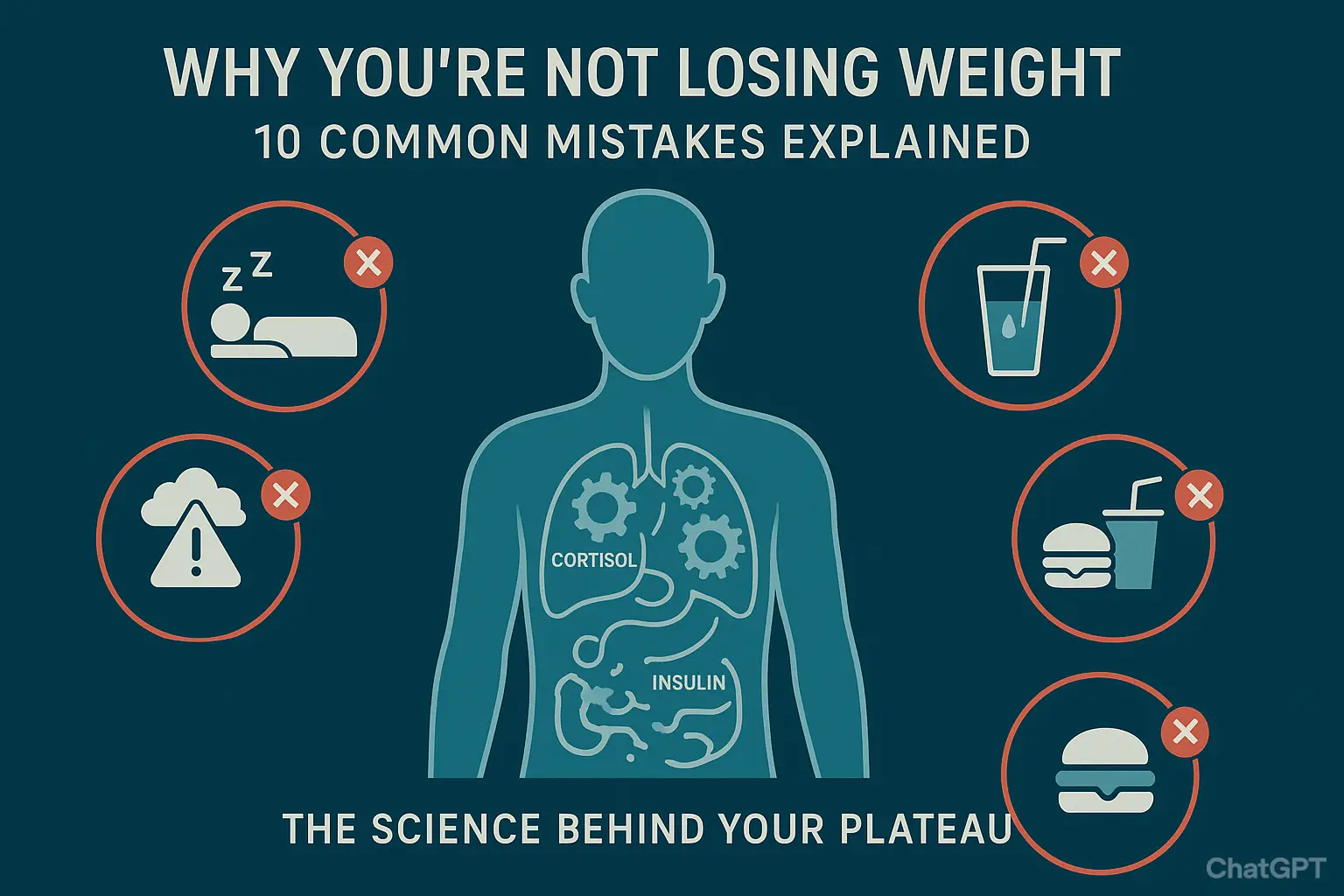
You’re putting in the work. You’re sweating, you’re saying “no” to desserts, and yet the number on the scale refuses to budge. It’s a frustrating and incredibly common experience. The truth is, weight loss is a complex process, and often, small, overlooked mistakes can create a big plateau. Before you throw in the towel, let’s diagnose the ten most common reasons why you’re not losing weight.
1. You’re Underestimating Your Calorie Intake.
This is the number one culprit. That splash of cream in your coffee, the “healthy” handful of nuts, the dressing on your salad—it all adds up. Studies consistently show people underestimate their food intake by up to 50%. For one to two weeks, track everything you eat and drink with a food scale and app to recalibrate your perception of portion sizes.
2. You’re Overcompensating for Exercise.
It’s easy to feel you’ve “earned” a treat after a workout, but that 500-calorie muffin can easily negate the 400 calories you just burned. This is known as reward eating. Exercise should not be a license to overconsume.
3. You’re Drinking Your Calories.
Lattes, sodas, juices, smoothies, and alcohol are liquid calories that don’t trigger the same feelings of fullness as solid food. They can add hundreds of empty calories to your day without you noticing. Stick to water, black coffee, and unsweetened tea as your primary beverages.
4. You’re Not Eating Enough Protein.
Protein is the powerhouse nutrient for weight loss. It boosts metabolism, reduces appetite, and helps preserve calorie-burning muscle mass while you diet. A meal low in protein will leave you hungry again soon. Ensure every meal contains a solid protein source like chicken, fish, eggs, Greek yogurt, or tofu.
5. You’re Neglecting Strength Training.
As covered in the myths, if you’re only doing cardio, you’re missing a key piece of the puzzle. Cardio burns calories, but strength training builds muscle, and muscle is metabolically active tissue. The more muscle you have, the higher your resting metabolic rate.
6. You’re Not Sleeping Enough.
Sleep is non-negotiable for weight management. Poor sleep (less than 7 hours) disrupts the hormones that control hunger—ghrelin (which makes you hungry) increases, and leptin (which makes you feel full) decreases. This is a biological drive to consume more calories.
7. You’re Stressed Out.
Chronic stress keeps your levels of the hormone cortisol elevated. High cortisol can increase appetite, drive cravings for sugary and fatty foods, and encourage your body to store fat, particularly in the abdominal area.
8. You Have an “All or Nothing” Mindset.
One “bad” meal or a missed workout doesn’t ruin your progress. But the belief that it does can. This mindset leads to “screw it” behavior—”I already ate a cookie, I might as well eat the whole box.” Progress is about the long-term trend, not daily perfection.
9. You’re Inconsistent.
Being perfect for three days and then completely falling off the wagon for four will yield zero results. Consistency over time is what creates change. Five consistent, “good enough” days are far better than two perfect ones followed by a burnout.
10. You’re Ignoring Non-Exercise Activity Thermogenesis (NEAT).
This is the energy you burn for everything you do that isn’t sleeping, eating, or sports-like exercise. If you work out for 30 minutes but are sedentary for the other 23.5 hours, your total daily calorie burn is low. Find ways to move more: take the stairs, walk on phone calls, park farther away.
Identify which of these mistakes resonate with you. Tackling even one or two can be the key that unlocks your stalled weight loss.