
For many people balancing busy work schedules, screen-heavy lifestyles, and limited time for exercise, squeezing in an effective workout can feel like a challenge. But fitness experts say you don’t always need a full gym—or even an hour—to train your entire body. With a single kettlebell and about 20 minutes, it’s possible to build strength, raise your heart rate, and improve long-term health.
The secret lies in the kettlebell itself. Unlike traditional dumbbells, the kettlebell features a handle attached to a rounded weight, allowing it to move in dynamic, swinging patterns. This design encourages functional movements that engage multiple muscle groups at once while challenging balance and stability.
“Kettlebells are versatile, portable, and taxing on the entire body during most movements and movement patterns,” says Lacee Lazoff, a trainer at a New York fitness studio. Even holding a heavy kettlebell close to the chest can activate the core, shoulders, arms, and back simultaneously.
That efficiency makes kettlebell training particularly appealing for people working out at home or trying to maintain a routine between long hours at a desk. Instead of isolating one muscle at a time, kettlebell workouts often mimic everyday movement patterns such as squatting, lifting, lunging, and rotating—skills the body uses daily.
Lazoff recently designed a simple full-body routine that takes roughly 20 minutes to complete and requires just one kettlebell. The structure is based on timed intervals rather than repetitions, helping exercisers focus on proper form rather than racing through counts.
The workout begins with a short warm-up designed to prepare joints and muscles for movement. Mobility exercises like the “world’s greatest stretch,” alternating lateral lunges, cat-cow spinal stretches, and seated hip switches loosen the hips, spine, and legs before the more demanding work begins.
From there, the routine moves into four circuits combining kettlebell exercises with bodyweight movements.
The first circuit blends power and core stability with kettlebell swings, forearm planks, and jump squats that transition into reverse lunges. These explosive movements elevate the heart rate quickly while activating the lower body and core.
Circuit two focuses on strength through controlled squats, push presses, and thrusters—an exercise that combines a squat with an overhead press. Together, these movements challenge the legs, shoulders, and upper body while reinforcing full-body coordination.
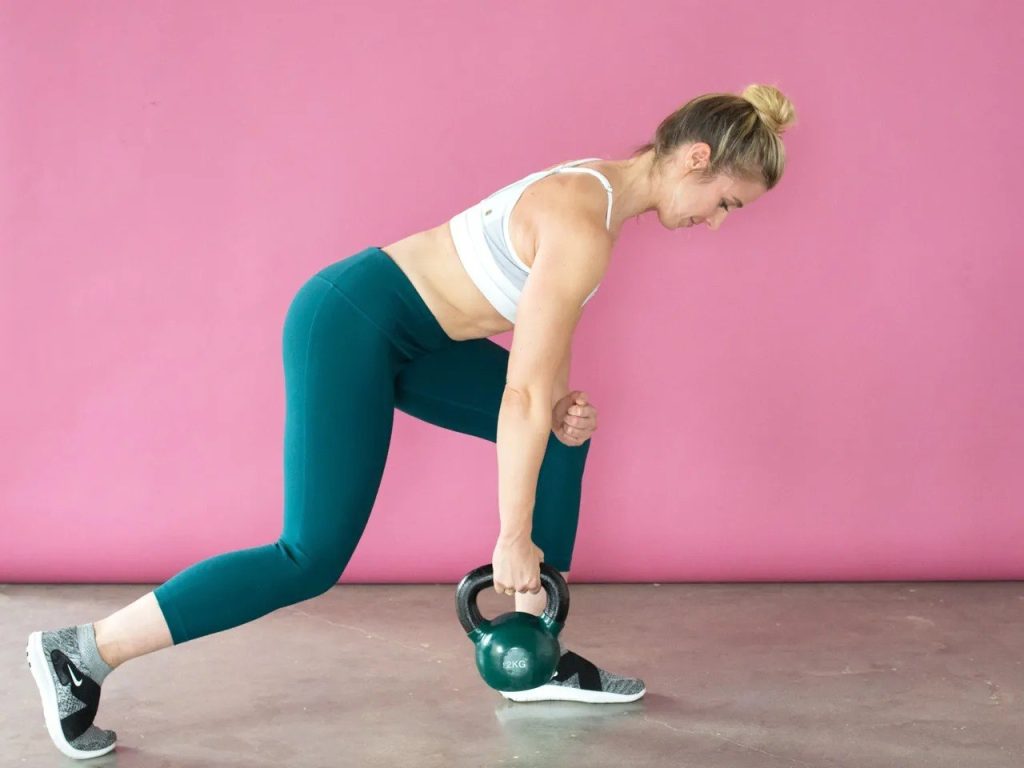
The third circuit introduces unilateral exercises that train one side of the body at a time. Dead cleans, lateral lunges, and bent-over rows help build balance, grip strength, and muscular symmetry—important elements often overlooked in traditional workouts.
Finally, the fourth circuit emphasizes core stability and coordination. Movements such as kneeling halos, around-the-world lunges, and walking push-ups challenge the shoulders, arms, and midsection while maintaining a steady cardiovascular demand.
According to trainers, the continuous movement is what makes the routine particularly effective. By linking exercises together with minimal rest, the workout blends strength training with cardio conditioning.
Experts recommend choosing a kettlebell that feels moderately challenging but still allows proper form throughout each movement. Beginners may benefit from starting with lighter weights and focusing on technique before increasing intensity.
For people who spend much of their day seated—whether working on a laptop, commuting, or scrolling through phones—short, functional workouts like this one can help counteract inactivity. The movements strengthen muscles used in everyday life while also improving mobility and endurance.
Ultimately, the appeal of kettlebell training lies in its simplicity. With just one piece of equipment and a small amount of time, exercisers can train their entire body in a way that supports strength, cardiovascular fitness, and long-term health.
In a world where time is often the biggest barrier to exercise, a focused 20-minute kettlebell routine may be all it takes to stay strong and active.