
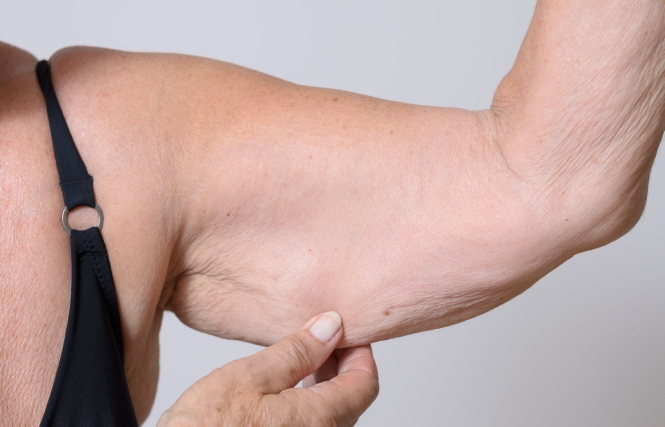
For millions of people, the loose, jiggling skin on the back of the upper arms (often called “bat wings”) has been a source of frustration and embarrassment.
Countless hours of triceps kickbacks, expensive creams, targeted fat-loss gadgets, and even costly clinical procedures have failed to deliver lasting results. According to Dr. Mandell, a physician with 15 years of clinical experience, there is a simple reason for this failure: almost everyone has been treating the wrong problem.
In a recent video, Dr. Mandell explains that saggy arms are not primarily a fat problem. “Targeted fat loss does not exist in any scientifically verified form,” he states. “No cream, no device, no body wrap removes fat from a specific spot.” Instead, the real culprit is a breakdown of connective tissue combined with sluggish fluid buildup beneath the skin—a condition known as fibrosis.

To understand the issue, Dr. Mandell breaks down the anatomy of the upper arm. Beneath the outer layer of skin lies subcutaneous fat, and below that sits a thin but critical sheet of tissue called the superficial fascia.
Fascia acts as the body’s internal wrapping material, holding everything in place and allowing layers to glide smoothly. When blood circulation in a specific area becomes chronically poor, sluggish over months or years, these layers stop sliding and begin sticking together.
This sticking and thickening is fibrosis, a scar-like tissue buildup that makes soft structures rigid and immobile when they should be loose and fluid.
The back of the upper arm is particularly vulnerable because it is one of the most neglected movement zones in the entire human body. The triceps muscle, which straightens the elbow, barely gets used in normal daily activities such as picking up objects, carrying bags, or holding a phone. Because the triceps and surrounding tissue sit in this movement dead zone, the microscopic circulation there becomes stagnant. Capillaries—the tiny blood vessels that deliver oxygen directly to cells—slow down, causing fluid to pool in the spaces between cells.
This creates what clinicians call subclinical edema: hidden fluid retention that adds weight and puffiness to the tissue. Gravity then pulls this fluid-laden, fibrotic, poorly circulated tissue downward, resulting in the familiar sag.

The good news, according to Dr. Mandell, is that this process can be reversed in just five to ten minutes per day, starting immediately, with no expensive equipment or clinic visits. The protocol involves three main components. First, manual pinch massage: taking very small pinches of the outermost skin layers on the back of the upper arm to physically break adhesions between the skin, fat layer, and fascia. This forces a separation of layers that should not be fused, reestablishing natural gliding planes and sharply increasing capillary blood flow, oxygen, and nutrients to the area. This, in turn, reactivates fibroblasts—the cells that produce collagen—ramping up the synthesis of new structural protein that tightens and firms the skin from within.
Second, narrow-grip push-ups keep the elbows pinned close to the rib cage, placing demand directly on the triceps muscle. For those who cannot perform floor push-ups, Dr. Mandell recommends starting with wall push-ups at a slight forward lean, then progressing to a window sill, then a sturdy chair, and finally the floor. This progressive overload builds muscle tone, improves blood flow, and provides structural support to the overlying skin.
Third, proper stretching before and after each strength session accelerates the removal of metabolic waste products and enhances nutrient delivery to recovering fibers. Dr. Mandell emphasizes that the shoulder is a complex and vulnerable joint, and those with a history of shoulder injury should avoid pushing through pain.
“Your skin on your arms is not your enemy,” Dr. Mandell concludes. “It is a messenger. Listen to what it is telling you. Address the root cause, and your whole body benefits, not just your arms.”