
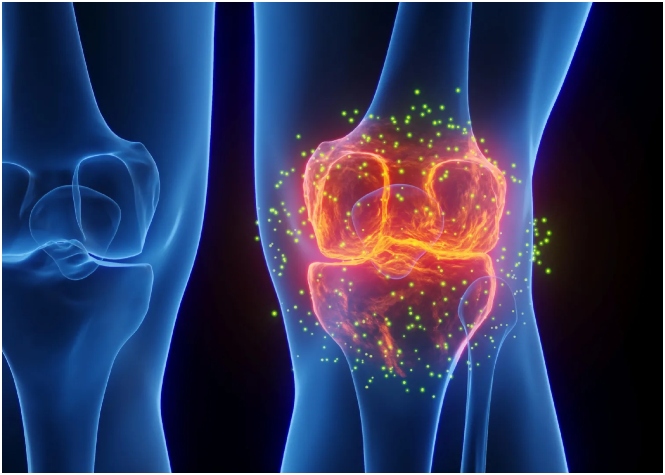
In a development that could change life for millions of people with creaky, painful knees, Stanford Medicine scientists have successfully regrown lost cartilage and reversed arthritis in older mice – using a drug that targets a single aging-related protein.
Even more promising: when researchers tested the same treatment on human cartilage samples removed during knee replacement surgeries, the tissue began producing new, healthy cartilage.
The findings, published in the journal Science, raise the possibility that one day a simple injection or even a pill could repair damaged joints rather than replace them.
The Problem: Millions Suffer, Few Options Exist
Osteoarthritis is the most common form of arthritis, affecting about one in five adults in the United States alone. The disease slowly breaks down cartilage – the smooth, slippery tissue that allows joints to move without pain. Over time, bones rub against bones. The result: pain, stiffness, swelling, and eventually, surgery.
Current treatments mostly focus on managing pain. When that fails, patients face knee or hip replacement surgery, a major operation with months of recovery. The disease generates an estimated $65 billion in direct health care costs each year.
What doctors don’t have is a single approved medication that can slow, stop, or reverse the disease itself.
Until now, possibly.
The Breakthrough: Blocking an ‘Aging Protein’
The Stanford team focused on a protein called 15-PGDH. Researchers describe it as a “gerozyme” – a class of proteins that becomes more abundant as we age and actively contributes to declining tissue function throughout the body.
Think of it as a chemical brake on your body’s ability to repair itself. The older you get, the harder that brake gets pressed.
When the scientists treated older mice with a drug that blocks 15-PGDH, something remarkable happened: cartilage that had become thinner and less functional with age grew back. The regenerated tissue was the good kind – smooth, slippery “hyaline cartilage” – not the less effective scar-like “fibrocartilage.”
“Cartilage regeneration to such an extent in aged mice took us by surprise,” said Nidhi Bhutani, PhD, associate professor of orthopedic surgery and one of the study’s senior authors. “The effect was remarkable.”
A Different Way to Heal
Most tissues in the body regenerate using stem cells – special cells that multiply and turn into new, specialized cells. Cartilage, it turns out, works differently.
Instead of relying on stem cells, the cartilage’s own cells – called chondrocytes (KON-dro-sites) – appear able to shift their genetic activity and return to a more youthful state.
“This is a new way of regenerating adult tissue, and it has significant clinical promise for treating arthritis due to aging or injury,” said Helen Blau, PhD, professor of microbiology and immunology and the study’s other senior author. “We were looking for stem cells, but they are clearly not involved. It’s very exciting.”
Preventing Arthritis After Sports Injuries
The team also tested whether the treatment could protect joints after an ACL-type injury – the kind of tear that happens in sports like soccer, basketball, and skiing when you suddenly stop, pivot, or jump.
Even after successful surgical repair, about half of people who tear their ACL develop osteoarthritis in that joint within about 15 years.
In the study, mice that received the drug twice weekly for four weeks after an injury were far less likely to develop arthritis. Treated mice also walked more normally and placed more weight on their injured leg – a sign of reduced pain.
Human Cartilage Responded, Too
Perhaps the most encouraging finding came from human tissue.
The researchers examined cartilage removed from people undergoing total knee replacement surgery for osteoarthritis. After just one week of treatment with the 15-PGDH inhibitor, the tissue showed fewer cartilage-degrading cells and began generating new, healthy articular cartilage.
“The mechanism is quite striking and really shifted our perspective about how tissue regeneration can occur,” Bhutani said. “It’s clear that a large pool of already existing cells in cartilage are changing their gene expression patterns.”
When Could This Be Available for People?
Here’s the exciting part: an oral version of a 15-PGDH inhibitor is already being tested in clinical trials for age-related muscle weakness. Phase 1 trials – the first step in testing safety in humans – have shown the drug is safe and active in healthy volunteers.
“Millions of people suffer from joint pain and swelling as they age,” Bhutani said. “It is a huge unmet medical need. Until now, there has been no drug that directly treats the cause of cartilage loss. But this gerozyme inhibitor causes a dramatic regeneration of cartilage beyond that reported in response to any other drug or intervention.”
Blau added: “Our hope is that a similar trial will be launched soon to test its effect in cartilage regeneration. We are very excited about this potential breakthrough. Imagine regrowing existing cartilage and avoiding joint replacement.”
The Bottom Line
This is still early-stage research, conducted in mice and human tissue samples, not living human patients. More studies and clinical trials are needed before a pill or injection for arthritis reaches your doctor’s office.
But for the millions of people who have been told their only option is to wait until their joints are bad enough for surgery, this breakthrough offers something that didn’t exist before: genuine hope.