Muscle Building & Strength Training

How to Build Muscle Effectively: A Complete Guide for Beginners and Beyond
Muscle Building & Strength Training

How to Build Muscle Effectively: A Complete Guide for Beginners and Beyond

Gaining muscle is one of the most common fitness goals, yet many people struggle to see consistent progress. The good news? Muscle growth (hypertrophy) is achievable for nearly everyone with the right combination of progressive resistance training, adequate nutrition, and patience. According to fitness science, building muscle occurs when your body deposits more protein into muscle tissue than it breaks down — a process driven primarily by heavy resistance training and sufficient protein intake. While hormones like testosterone and growth hormone play roles, the two most controllable factors remain consistent strength training and proper fueling. The Science of Muscle Growth Skeletal muscle fibers contract to produce force. When you train with moderate to heavy loads, you crea...

The Law of Adaptation: Why You Don’t Need Heavier Weights to Get Stronger
Muscle Building & Strength Training

The Law of Adaptation: Why You Don’t Need Heavier Weights to Get Stronger

If you believe the only way to get stronger is to stack more iron onto the barbell every single week, you aren’t just hitting a plateau—you’re headed for an injury or a burnout. We’ve been conditioned to think of "Progressive Overload" as a simple math equation: More Weight = More Muscle. But the human body is far more sophisticated than a calculator. True strength training is about the Law of Adaptation, the biological principle where your body forced to change because the demands placed upon it have evolved. Eventually, the "just add weight" strategy fails. You can’t add five pounds to your bench press every week forever, or we’d all be world-record holders within three years. To keep growing, you have to find "invisible" ways to make the work harder. Here are seven ways to trigger mu...
What Sled Pushes Can Really Do for Your Body – A Full-Body Power Move Endorsed by Fitness Experts
Muscle Building & Strength Training

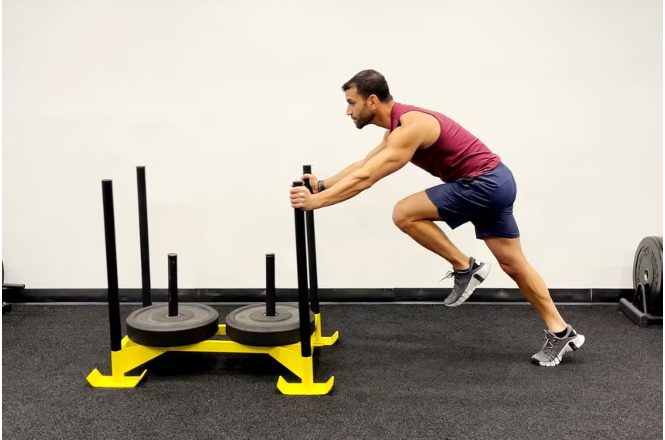
What Sled Pushes Can Really Do for Your Body – A Full-Body Power Move Endorsed by Fitness Experts

If you’ve spotted someone pushing a weighted sled across the gym floor and wondered what all the effort is for, you’re not alone. The exercise—popularized in recent social media posts by longtime TODAY Show anchor Al Roker—has gained attention as a simple yet incredibly effective full-body workout. Fitness professionals say sled pushes deliver serious benefits for strength, cardiovascular health, joint function, and workout variety. What Exactly Are Sled Pushes?Sled pushes involve driving a weighted metal sled (loaded with plates) forward across a smooth surface, usually turf or a gym floor. The movement requires constant force, engaging nearly every major muscle group. Certified exercise physiologist Emily Hernandez, MS, EP-C, with Orlando Health, explains that the sled creates dyn...
Are You Lifting Heavy Enough? Why Light Weights May Be Holding Back Your Weight Loss Goals
Muscle Building & Strength Training

Are You Lifting Heavy Enough? Why Light Weights May Be Holding Back Your Weight Loss Goals

If your weight-training routine has plateaued or you're not seeing the fat loss you expected, the answer might be simple: you're probably not lifting enough weight. A growing body of fitness research and expert guidance shows that lifting heavier loads—within safe limits—is often key to stimulating muscle growth, boosting metabolism, and transforming body composition. Strength training, also known as resistance or weight training, remains one of the most effective tools for sustainable weight loss. Muscle tissue is metabolically active: one pound of muscle burns roughly 10–30 calories per day at rest, compared to just 5–10 calories for the same amount of fat. Building lean muscle therefore raises your resting metabolic rate, helping you burn more calories around the clock—even when you'...
7 Gentle Stretches to Ease Lower Back Pain and Boost Mobility – Expert Tips for Safe Relief
Muscle Building & Strength Training

7 Gentle Stretches to Ease Lower Back Pain and Boost Mobility – Expert Tips for Safe Relief

Accra, Ghana – Lower back pain affects millions worldwide, often stemming from sedentary lifestyles, repetitive strain, muscle pulls, or even underlying conditions such as kidney stones or acute pancreatitis. While stretching alone isn’t a cure-all, targeted, gentle exercises can significantly reduce tension, improve flexibility in inflamed muscles, and enhance overall spinal mobility. Health experts emphasize starting slowly, listening to your body, and consulting a doctor before beginning any new routine—especially if pain follows an injury or accompanies other symptoms. The National Institute of Neurological Disorders and Stroke (NINDS) advises favoring low-impact movements that strengthen the back and core while avoiding sudden jolts that could worsen strain. Here are seven evide...
The Metabolic Tug-of-War: Is Your Nutrition Fueling the Lift or Feeding the Recovery?
Muscle Building & Strength Training

The Metabolic Tug-of-War: Is Your Nutrition Fueling the Lift or Feeding the Recovery?

The human body is not a static furnace that burns wood at a constant rate; it is a sophisticated biological engine that thrives when the highest-octane fuel hits the system exactly when the pistons are firing hardest. In the world of elite body composition, the "when" is often just as vital as the "what." Two strategies have dominated the conversation on how to synchronize this fueling: Peri-workout nutrition and the more controversial Carb Backloading. While they share the goal of muscle hypertrophy and fat loss, they approach the metabolic window from polar opposite directions. 1. The Peri-Workout Window: The Power of Proximity Peri-workout nutrition refers to the specific nutrients consumed immediately before, during, and after training. The philosophy here is preventative mainten...
The Hypertrophy-Strength Paradox: Building the Engine vs. Tuning the Wiring
Muscle Building & Strength Training

The Hypertrophy-Strength Paradox: Building the Engine vs. Tuning the Wiring

The gym floor is a sanctuary where two distinct archetypes collide: the lifter who wants to look like a mountain and the lifter who wants to move one. While the casual observer might think a heavyweight is just a heavyweight, your nervous system and your muscle fibers disagree. Choosing between hypertrophy—the literal enlargement of muscle tissue—and pure strength—the ability of that tissue to produce force—is the fork in the road that dictates whether you are building a show car or a tractor. 1. The Fiber Architecture: Size vs. Density Hypertrophy training focuses on "sarcoplasmic" expansion, increasing the fluid and energy-storing components within the muscle cell. Think of it as inflating a balloon. Strength training, conversely, prioritizes "myofibrillar" hypertrophy, thickening ...
The Protein Cap Myth: Why Your Muscles Don’t Have a Thirty Gram Limit
Muscle Building & Strength Training

The Protein Cap Myth: Why Your Muscles Don’t Have a Thirty Gram Limit

For years, the "30-gram rule" has patrolled the dining halls of the fitness world like a relentless drill sergeant, barking at every lifter who dared to eat more than a single chicken breast in one sitting. The old myth claims that if you consume a gram over that magic number, your body simply tosses the excess into the metaphorical trash can—or worse, converts it straight to body fat. But as we peel back the layers of human physiology, we find that the body is far more efficient (and hungrier) than the old guard gave it credit for. Here is the truth about anabolic eating and the actual limits of protein absorption. The Digestive Buffer Your gut is a master of logistics, not a leaky bucket. When you consume a massive bolus of protein—say, a 16-ounce ribeye—your small intestine doe...
The Iron Price: Why Your Joints Should Outlast Your Personal Records
Muscle Building & Strength Training

The Iron Price: Why Your Joints Should Outlast Your Personal Records

If you treat your body like a disposable rental car, don’t be surprised when the wheels fall off just as you’re reaching peak performance. We often obsess over the size of our biceps or the weight on the deadlift bar, but the "connective tissue" holding that muscle to the bone is the true unsung hero of the gym. You can have the strongest engine in the world, but if the chassis is rusted and the bolts are loose, you aren't going anywhere. To lift heavy for decades rather than months, you must stop viewing joint health as an afterthought and start seeing it as the ultimate insurance policy for your strength. Here is how to bulletproof your elbows, knees, and shoulders while still chasing the heavy iron. 1. Respect the "Cold Starts" Think of your synovial fluid—the lubricant in ...
Breathe Harder, Perform Better: The Science and Strategy of High Altitude Fitness Training
Muscle Building & Strength Training

Breathe Harder, Perform Better: The Science and Strategy of High Altitude Fitness Training

For athletes constantly seeking an edge, the path to peak performance sometimes lies miles above sea level. High altitude fitness training, also known as elevation training, has become a cornerstone strategy for endurance athletes looking to unlock new levels of cardiovascular capacity. But is it just about struggling for air, or is there genuine science behind the hype? Training where the air is thin forces the body to adapt in remarkable ways. By understanding the physiology and following a smart protocol, athletes can return to sea level stronger, faster, and more resilient. Here’s what you need to know about training at altitude. The Physiological Edge: More Than Just Thin Air When you exercise at high altitudes, the lower oxygen levels (hypoxia) place unique stress on the...